Common Lab Billing Denials and How to Fix Them
The 10 most common lab claim denials, from missing CLIA numbers and QW modifiers to medical necessity, frequency limits and panel unbundling, with fixes for each.
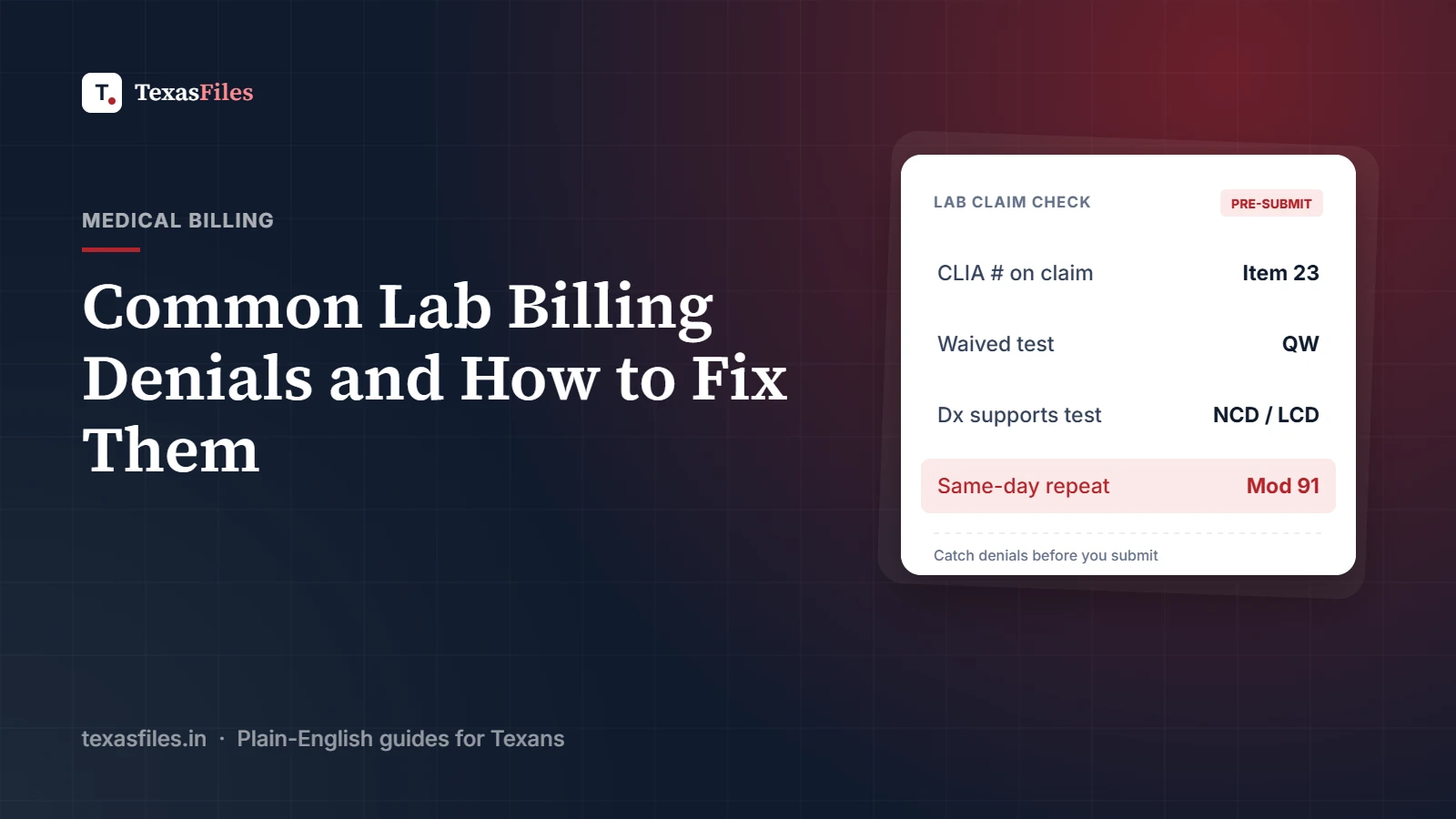
Lab claims are small in dollar value but huge in volume, and that combination makes them one of the most frustrating areas of medical billing. A single missing CLIA number or an unsupported diagnosis code can deny dozens of claims at once, and each one costs more to rework than it pays. The good news: most lab denials come from a short list of predictable problems that can be caught before the claim ever leaves your system.
This guide covers the most common lab billing denials, why they happen, and how to fix and prevent each one.
1. Missing or Invalid CLIA Number
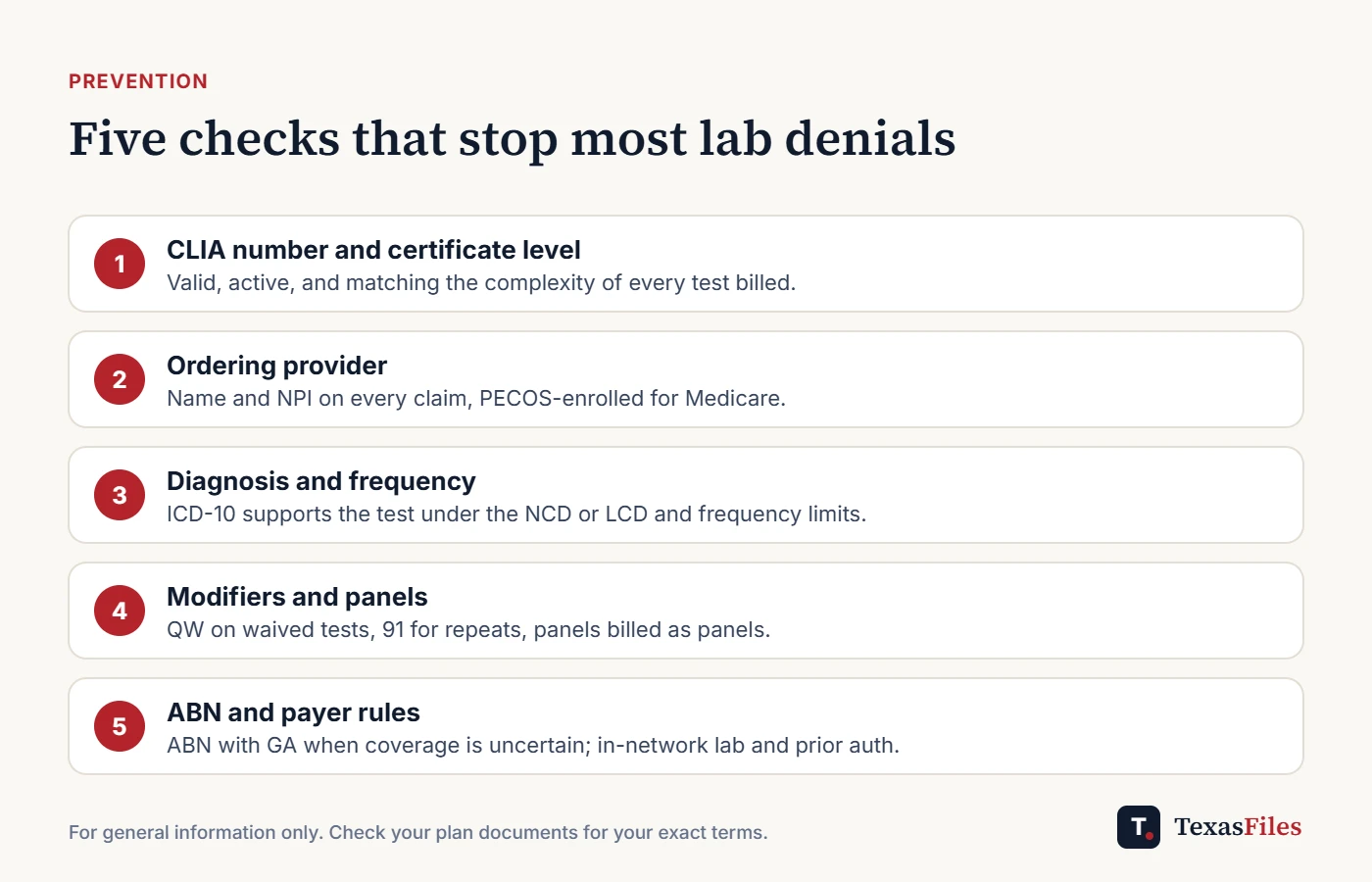
Every facility that performs laboratory testing on human specimens, including a physician office running rapid strep or urine dip tests, must hold a CLIA certificate. Medicare and many commercial payers deny lab claims that don't include a valid CLIA number, or that bill tests above the level the certificate allows.
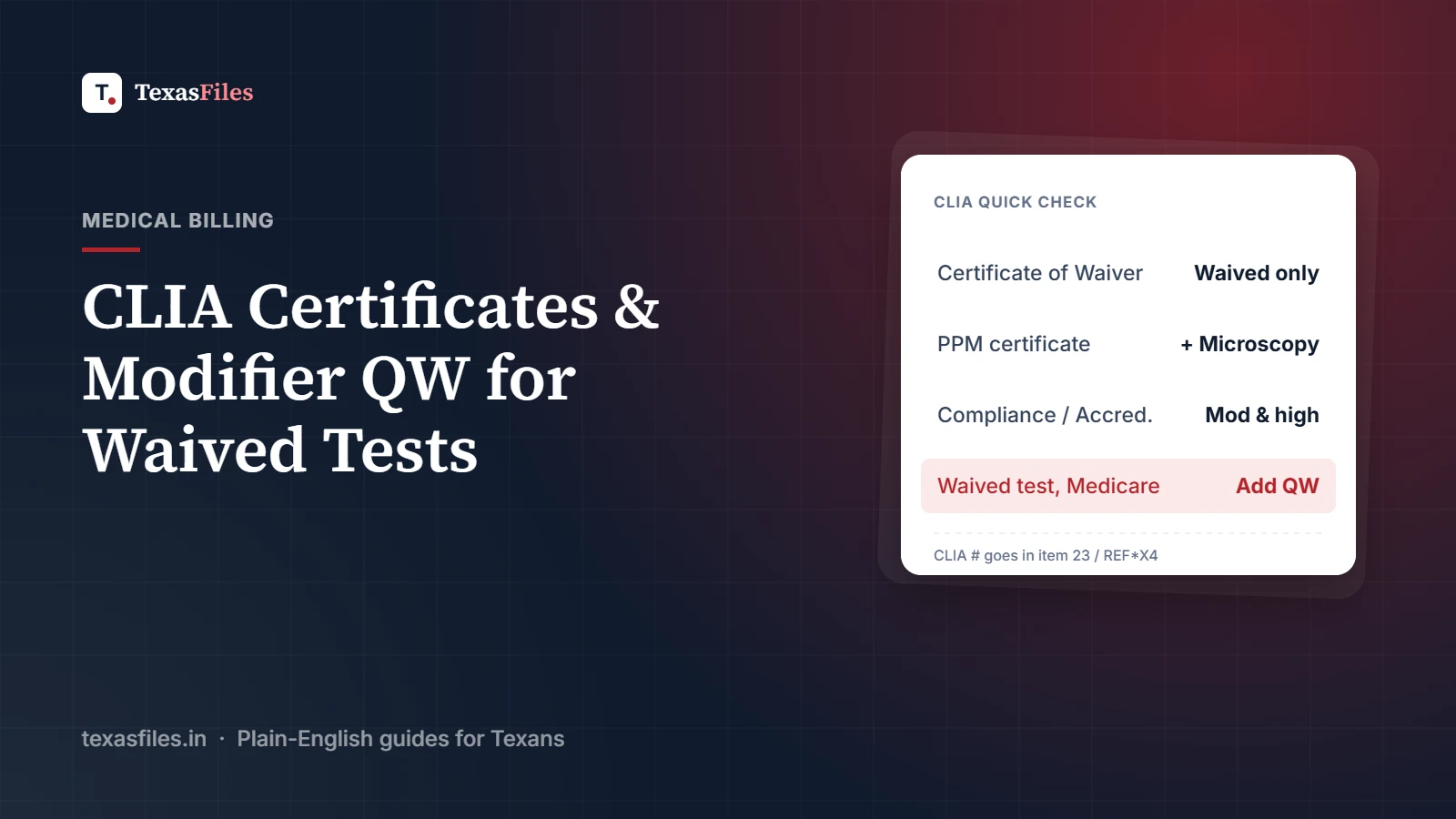
Where it goes: Item 23 on the CMS-1500 paper claim, or the REF segment with qualifier X4 in loop 2300 (or loop 2400 at the line level) on the 837P electronic claim.
Common causes: The number was never added to the practice management system, an expired certificate, or a Certificate of Waiver used to bill moderate- or high-complexity tests.
Fix: Store the CLIA number at the location level so it flows automatically onto every lab claim, and track the certificate's expiration date. Our guide to CLIA certificates and the QW modifier explains the details.
2. Missing QW Modifier on Waived Tests
Medicare requires modifier QW on most CLIA-waived tests billed by labs with a Certificate of Waiver. Without it, the claim is rejected or denied, even if the test itself is covered. A small number of waived tests are exempt from the QW requirement, so check the current CMS list.
3. Medical Necessity Denials
This is the largest category of lab denials. Medicare covers diagnostic lab tests only when the diagnosis on the claim supports the test under a National Coverage Determination (NCD), a Local Coverage Determination (LCD), or general medical necessity rules.
Common causes: A vague or unsupported ICD-10 code, a screening code on a diagnostic test, or the ordering provider's diagnosis never making it onto the claim.
Fix: Run diagnosis-to-test edits against the applicable NCDs and LCDs before submission, and ask ordering providers for the most specific diagnosis the record supports.
Protect revenue: When a test may not be covered, give the patient an Advance Beneficiary Notice (ABN) before the specimen is collected. See our guide to lab medical necessity, NCDs, LCDs, and ABNs.
4. Frequency Limits Exceeded
Many lab tests have coverage limits on how often they can be performed. For example, Medicare's NCDs limit how frequently tests such as hemoglobin A1c and lipid panels are covered for monitoring, and preventive screenings have their own intervals. When a patient's previous test was performed by another lab or provider, you may not know it until the denial arrives.
Fix: Build frequency checks into your claim scrubber, check eligibility and prior test history where available, and get an ABN when a test may exceed the limit.
5. Missing or Invalid Ordering Provider
Lab claims must identify the provider who ordered the test. For Medicare, the ordering provider must have a valid NPI and be enrolled in Medicare (PECOS) in an eligible specialty. Claims with a missing, misspelled, or non-enrolled ordering provider are denied.
Fix: Capture the ordering provider's full name and NPI on every requisition, and verify enrollment for providers outside your practice.
6. Panel Unbundling and NCCI Edits
Organ and disease panels, such as a comprehensive metabolic panel (80053) or a lipid panel (80061), must be billed using the panel code when all component tests are performed. Billing the components individually is unbundling and triggers NCCI edits or recoupments.
Common causes: Lab interfaces that send individual test codes, or panels ordered with extra components that aren't mapped correctly.
Fix: Map panels correctly in your lab interface, and bill any extra tests separately in addition to the panel code.
7. Duplicate Claims and Repeat Tests
When the same test is performed more than once on the same day, payers often deny the second line as a duplicate. If the repeat test was medically necessary to obtain subsequent results, such as serial glucose or troponin levels, modifier 91 tells the payer it's a separate, intentional test. Modifier 91 should not be used when a test is rerun because of a specimen problem, equipment failure, or to confirm a result. Learn more in our guide to lab billing modifiers.
8. Wrong Billing Entity or Reference Lab Issues
When a practice sends a specimen to an outside lab, who bills for the test matters. Medicare generally requires the lab that performs the test to bill for it directly, with limited exceptions. Some commercial payers allow the referring practice to bill using modifier 90, while others require the performing lab to bill. Billing the wrong way leads to denials or overpayment demands.
9. Out-of-Network Lab
Many commercial health plans contract with a limited set of labs. Specimens sent to an out-of-network lab can be denied or paid at out-of-network rates, often leaving patients with surprise bills. Some plans also use lab benefit management programs that require notification or prior authorization for certain tests, especially genetic and molecular testing.
Fix: Check the patient's plan before choosing where to send specimens, and keep a payer-to-lab reference list for your staff.
10. Timely Filing
Lab claims often wait on results, ordering information, or diagnosis codes, which can push them past payer filing deadlines. Medicare's deadline is generally 12 months from the date of service; commercial payers are often shorter.
Fix: Track unbilled lab encounters daily and escalate any missing information quickly.
A Prevention Checklist for Every Lab Claim
Valid, active CLIA number at the right certificate level
QW modifier on waived tests when required
Ordering provider name and NPI, enrolled for Medicare
Most specific diagnosis code supporting the test
NCD and LCD diagnosis and frequency edits passed
ABN on file, with the correct modifier, when coverage is uncertain
Panels billed as panels, with no unbundled components
Correct repeat-test modifier when applicable
In-network lab and any required prior authorization confirmed
Running every claim through a claim scrubber that checks NCCI edits, units, and modifiers before submission catches many of these issues automatically.
Frequently Asked Questions
Why are lab claims denied more often than other claims?
Lab tests are tightly tied to diagnosis-based coverage rules and frequency limits, and lab claims often depend on information from an ordering provider outside the billing office.
Can I bill the patient if Medicare denies a lab test as not medically necessary?
Only if you gave the patient a valid ABN before the service and billed with the appropriate modifier. Without an ABN, the provider generally can't bill the patient.
Should I appeal lab denials?
Yes, when the denial is wrong, such as a correct diagnosis that wasn't processed properly. For small-dollar lab claims, fixing the root cause and correcting the claim is often faster than a formal appeal. See our guide to appealing denied claims.
The Bottom Line
Most lab denials trace back to a handful of fixable issues: CLIA numbers, modifiers, diagnosis support, frequency limits, ordering provider data, and panel coding. Build checks for each into your workflow, track denial trends by reason code, and fix the root cause instead of reworking the same denials every month.
Keep reading
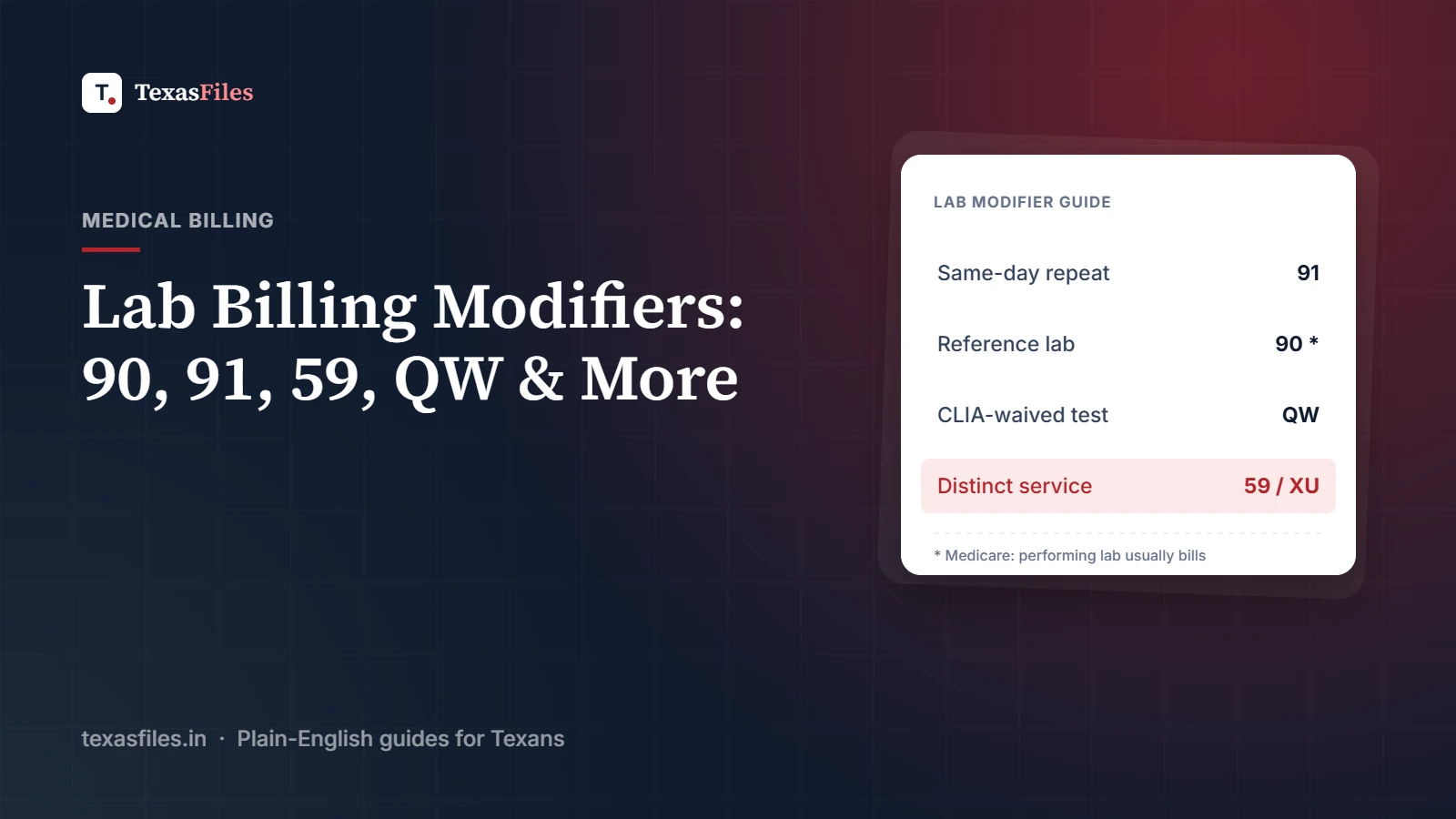
Lab Billing Modifiers Explained: 90, 91, 59, QW, and More
When to use lab modifiers 91, 90, QW, 59 and the X modifiers, 26 and TC, and ABN modifiers, plus the common mistakes that cause duplicate and bundling denials.
·4 min read
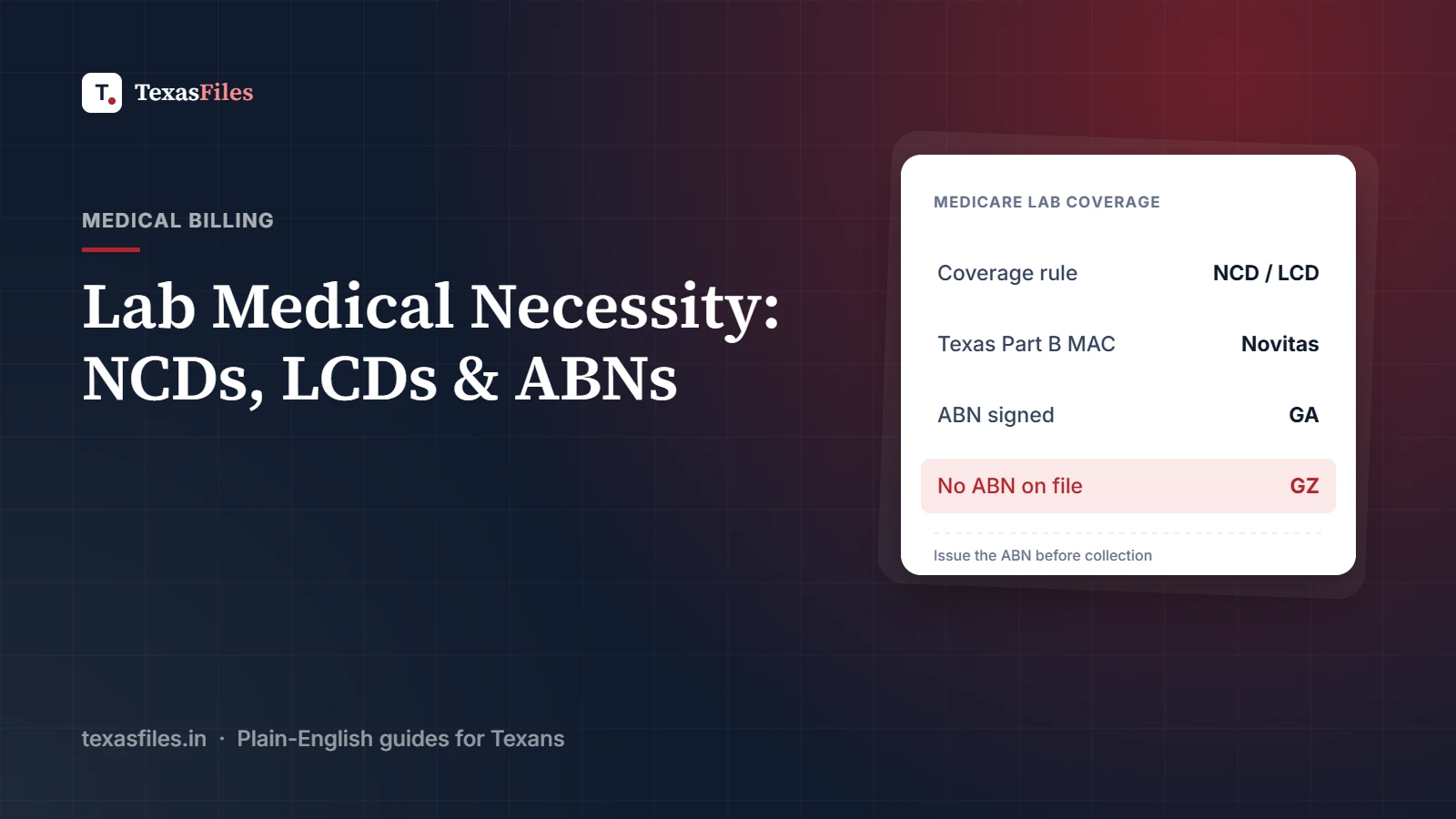
Lab Medical Necessity: NCDs, LCDs, and ABNs Explained
How Medicare decides if a lab test is covered: lab NCDs, Novitas LCDs, frequency limits, and when to use an ABN with modifiers GA, GZ, GX and GY.
·5 min read
CLIA Certificates and Modifier QW: Billing Waived Lab Tests
CLIA certificate types, where the CLIA number goes on the CMS-1500 and 837P, and when Medicare requires modifier QW for waived lab tests.
·4 min read