CO-29 Timely Filing Denials: Filing Limits, Proof, and How to Appeal
What a CO-29 timely filing denial means, Medicare's one-year limit, Texas's 95-day rule for insured plans, what counts as proof of timely filing, and how to appeal.
A CO-29 denial is the payer saying: we received this claim too late, and we won't pay it. Unlike most denials, you can't fix it by correcting a code or adding a modifier. The only ways to win are to prove the claim was filed on time, or to show that one of the payer's exceptions applies. That makes CO-29 one of the most expensive denials a practice can get, and one of the most preventable.
This guide covers what CO-29 means, typical filing limits, what counts as proof of timely filing, and how to appeal.
What CO-29 Means
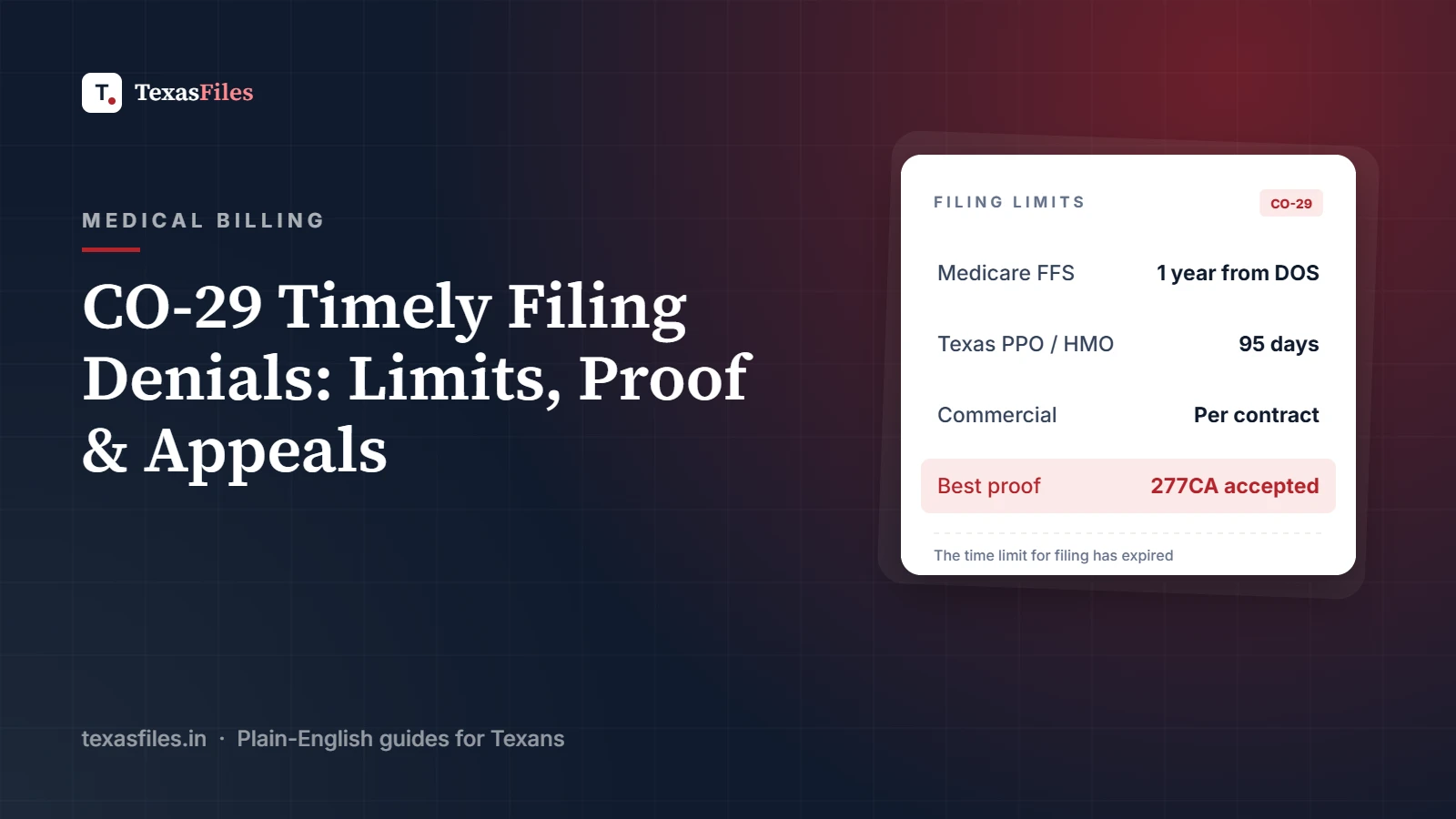
The X12 description of reason code 29 is short: "The time limit for filing has expired." With group code CO, the provider has to write off the balance and can't bill the patient for it. That's why a timely filing denial is a direct loss for the practice, not just a delay.
Timely Filing Limits: How Long Do You Have?
Every payer sets a filing limit, usually counted from the date of service (for professional claims) or the discharge date (for inpatient facility claims). Common limits:
Medicare fee-for-service: one calendar year from the date of service. Federal regulation (42 CFR 424.44) requires claims to be filed "no later than the close of the period ending 1 calendar year after the date of service."
Medicaid: set by each state program, and often shorter for some claim types. Check your state Medicaid provider manual.
Medicare Advantage and commercial plans: set by the provider contract and the payer's provider manual. Many participation agreements use limits such as 90 or 180 days; non-participating limits can be different.
Texas insured PPO and HMO plans: under the Texas prompt pay statute, a physician or provider must submit a claim no later than the 95th day after providing the service, unless the contract allows longer (Texas Insurance Code §1301.102 for PPO plans and §843.337 for HMOs). Missing it forfeits the right to payment.
Secondary claims: many payers count the secondary limit from the date of the primary payer's EOB, not the date of service. Check the payer's policy.
Self-funded employer plans (ERISA plans), including many administered by large carriers and third-party administrators, are not subject to state prompt pay laws. Their limits come from the plan document and your contract with the network.
What Counts as Proof of Timely Filing
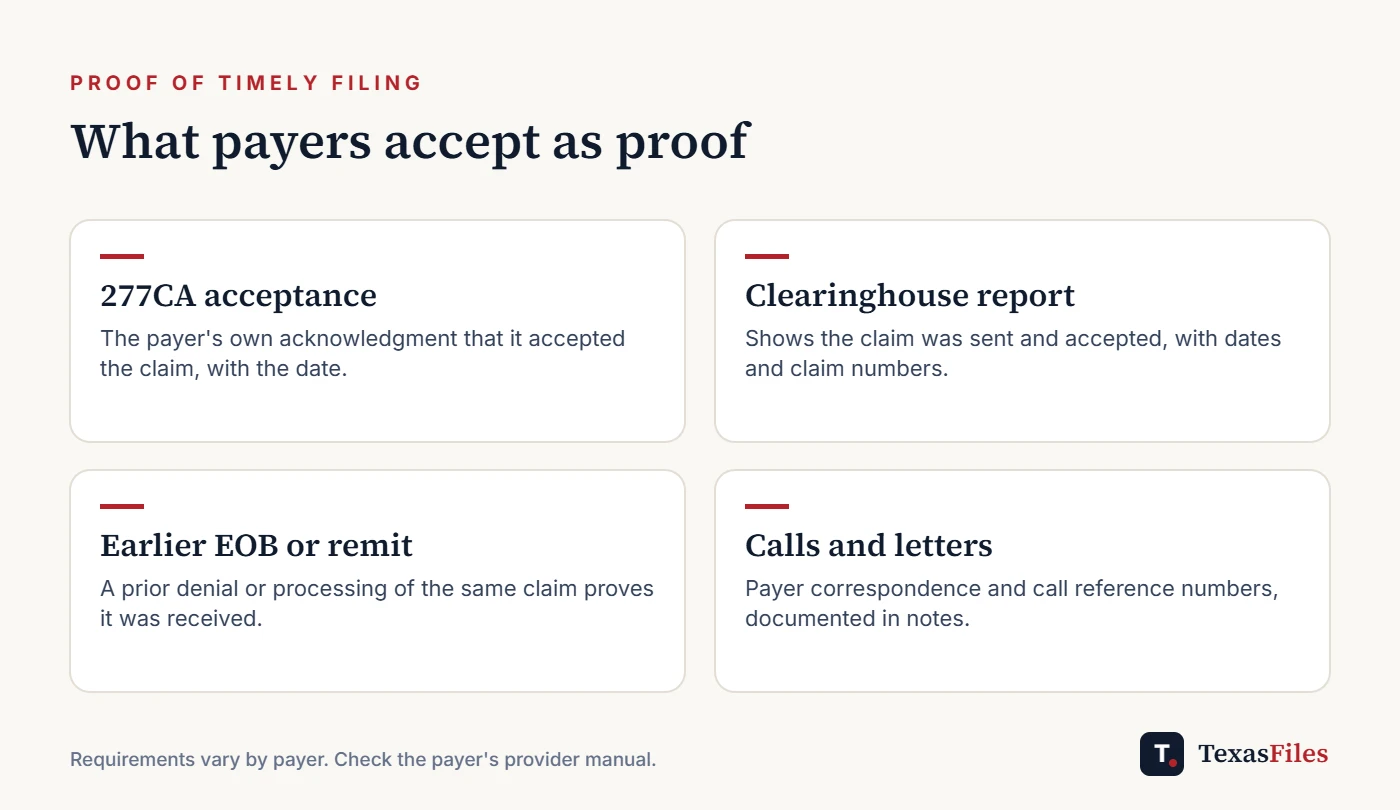
When a payer says a claim was late but you believe it wasn't, the appeal stands or falls on your proof. Strong proof includes:
The payer acceptance report. The 277CA claim acknowledgment showing the payer accepted the claim, with the date. This is the gold standard for electronic claims.
Clearinghouse reports. Acceptance reports from your clearinghouse (for example, Office Ally or Availity) showing the claim was sent and accepted, with dates and payer claim numbers. A report that only shows the clearinghouse received the claim is weaker than one showing the payer accepted it.
A prior EOB or remit for the same claim. If the payer denied or processed the claim earlier for another reason, that's proof it was received in time.
Payer correspondence, such as a request for records or a letter asking for COB information, which shows the payer had the claim.
Call reference numbers where a representative confirmed the claim was on file, documented in your notes with date and name.
Certified mail receipts for paper claims.
A screenshot of your own practice management system showing a "billed" date is usually not enough on its own. Payers want evidence from outside your system.
Why Claims Go Out Late
Rejections nobody worked. A claim rejected at the clearinghouse or payer front end was never received. If the rejection sits unworked, the clock keeps running.
Wrong payer. Billing the wrong plan, or the wrong address for a Medicare Advantage plan, burns weeks.
COB holds. Waiting on coordination of benefits updates doesn't stop the filing clock for the correct payer.
Missing charges. Encounters not closed by the provider, or lab and hospital charges entered weeks later.
New patient insurance discovered late. The patient gave old insurance at check-in and the new plan surfaces months later.
How to Appeal a CO-29 Denial
1. Confirm the dates. Check the date of service, the original submission date, and the payer's filing limit for your contract. Make sure the payer measured from the right date (for example, the primary EOB date on a secondary claim).
2. Gather proof. Pull the 277CA or clearinghouse acceptance report, earlier remits, and call notes.
3. Use the payer's process. Many payers handle timely filing through a reconsideration or appeal form with proof attached. Some accept proof of timely filing through their portal.
4. Explain the timeline clearly. One short paragraph: date of service, date first submitted, date accepted, what happened next, and why the claim is within the limit.
5. Ask about exceptions. Payers often have exceptions for retroactive eligibility, payer error, or coverage discovered late. For Medicare, the limited exceptions are written into 42 CFR 424.44, such as errors by Medicare or its contractors, or retroactive Medicare entitlement.
If you don't have proof that the claim was filed on time, and no exception applies, the appeal won't succeed. The balance is a write-off, and the lesson is in the root cause.
How to Prevent Timely Filing Denials
Work clearinghouse and payer rejections daily. A rejected claim is an unfiled claim.
Run an unbilled encounters report every week and chase anything older than a few days.
Keep a payer filing-limit list for every contract, including secondary and corrected-claim limits.
Set follow-up dates well inside the limit: check claim status if there's no response within 30 days of submission.
Save acceptance reports. Clearinghouses don't keep reports forever, so store them or make sure you can retrieve them.
For Texas insured plans, remember the 95-day rule, which is shorter than many billers expect.
Frequently Asked Questions
What is the timely filing limit for Medicare?
For traditional Medicare, claims must be filed within one calendar year from the date of service. Medicare Advantage plans set their own limits in provider contracts.
Can I bill the patient for a timely filing denial?
No. A CO-29 denial is a contractual write-off. In-network providers generally can't bill the patient for a claim the practice filed late.
Does a rejected claim count as filed on time?
Usually not. A rejected claim was never accepted by the payer. Some payers will accept a rejection report as proof of a good-faith attempt, but most require the claim to have been accepted within the limit.
Is the Texas 95-day rule the same for every plan?
No. It applies to state-regulated insured PPO and HMO plans. Self-funded employer plans, Medicare and Medicaid follow their own rules, and a contract can allow a longer period.
The Bottom Line
CO-29 is a proof problem. If you can show the claim was accepted on time, you can usually win. If you can't, the money is gone. Work rejections daily, save acceptance reports, and track every payer's limit so the question never comes up.
Sources
Written by Ashim
Ashim works in US medical billing and revenue cycle management, handling claim follow-up, denials and appeals every day.
Read our editorial policy. Spotted something outdated? Tell us.
Keep reading
Common Causes of CO-97 Denials (and How to Fix Them)
CO-97 means the payer bundled a service into another one. Learn the common causes, like NCCI edits, missing modifiers, and global periods, and how to fix them.
·4 min read
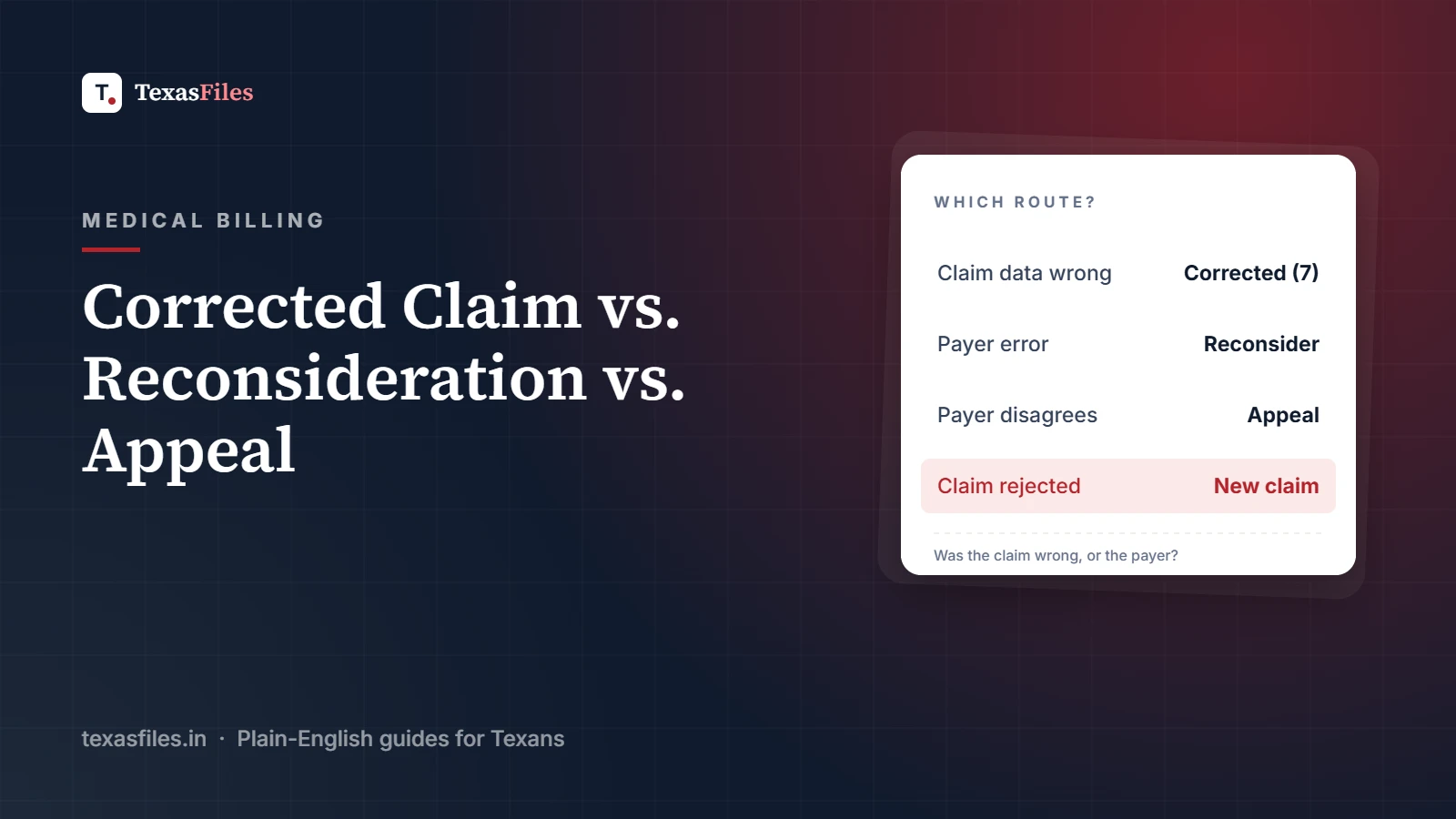
Corrected Claim vs. Reconsideration vs. Appeal: Which One to Use
When to send a corrected claim (frequency code 7 or 8), when to ask for reconsideration, and when to file a formal appeal, including Medicare reopenings and appeal deadlines.
·6 min read
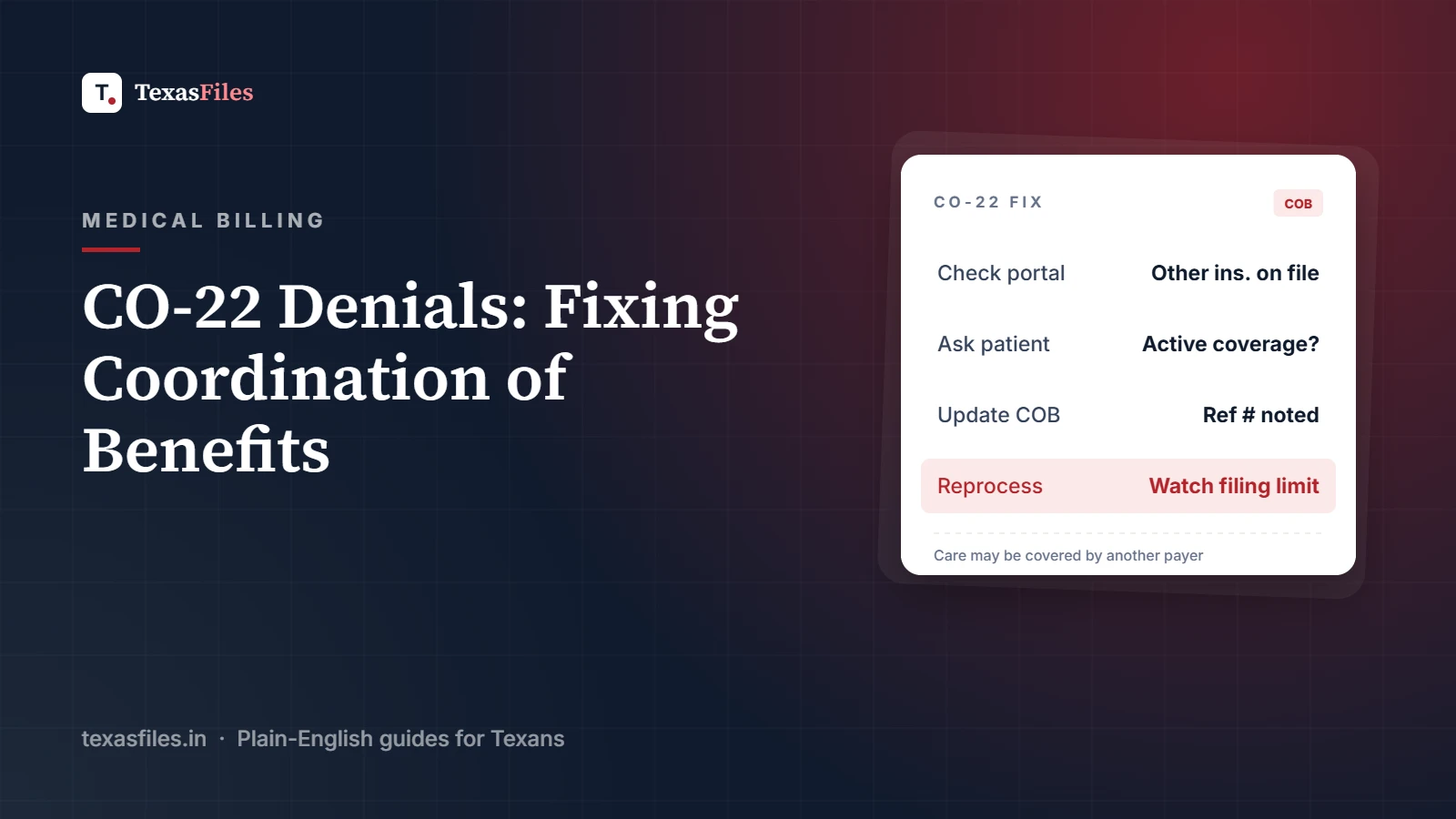
CO-22 Denial: How to Fix Coordination of Benefits Denials
What a CO-22 denial means, who pays first under COB and Medicare Secondary Payer rules, and a step-by-step process to get COB updated and claims reprocessed.
·6 min read