Common Causes of CO-97 Denials (and How to Fix Them)
CO-97 means the payer bundled a service into another one. Learn the common causes, like NCCI edits, missing modifiers, and global periods, and how to fix them.
Few denials frustrate billers more than CO-97. The claim was received and processed, but one line paid $0. The payer's explanation: "The benefit for this service is included in the payment/allowance for another service/procedure that has already been adjudicated." Put simply, the payer thinks the service is bundled into something else it already paid for.
Because the group code is CO (Contractual Obligation), you usually cannot bill the patient for the denied amount. The money is lost unless you correct the claim or appeal. Here are the most common reasons CO-97 shows up and what to do about each one.
1. NCCI procedure-to-procedure (PTP) edits
This is the most common cause. The National Correct Coding Initiative (NCCI) pairs codes that normally shouldn't be paid together on the same day for the same patient. When both codes appear on the claim, the "column 2" code is denied as included in the "column 1" code. Commercial payers often use NCCI or their own similar edits.
Fix: Look up the code pair in the current NCCI PTP table. If the modifier indicator is 0, the codes can never be billed together, so the denial stands. If it's 1 and the service really was separate (a different site, a different session, or a separate incision), add the right modifier and resubmit.
2. Missing or wrong modifier
Many CO-97 denials happen because a modifier wasn't added. Common ones:
Modifier 25 for a significant, separately identifiable E/M service on the same day as a procedure
Modifier 59 / XE, XS, XP, XU for distinct procedural services
Modifiers 24, 57, 79 for services during or around a global period (see below)
Anatomic modifiers (RT, LT, F1–F9, TA–T9) to show different body sites
Fix: Only add a modifier when the documentation supports it. Modifier 59 is heavily audited, so use the more specific X{EPSU} modifiers when the payer accepts them.
3. Global surgical package
Surgical procedures include routine pre-op and post-op care. A major procedure has a 90-day global period, which includes the day before surgery. A minor procedure has a 0- or 10-day global period. If an E/M visit or other service is billed during that window without a modifier, the payer bundles it into the surgery.
Fix: Check the global days for the surgical CPT code. Use 24 for an unrelated E/M during the post-op period, 25 for a significant separate E/M on the day of a minor procedure, 57 for the decision for surgery, and 79 for an unrelated procedure during the post-op period.
4. Another provider already billed the global service
Sometimes the CO-97 is triggered by someone else's claim. For example, the surgeon billed the global package, and your follow-up visit or post-op care is now treated as included.
Fix: Call the payer or check the portal to find out which claim the line was bundled into. If care was split, use the split-care modifiers (54, 55, 56) and coordinate with the other provider.
5. Incidental or integral services
Some services are considered part of the main procedure and are never paid separately. Examples include local anesthesia given by the surgeon, simple wound closure that is part of the procedure, and venipuncture or IV access that is part of an infusion.
Fix: Usually none. Learn which codes are always bundled and stop billing them separately so you aren't creating avoidable denials.
6. Supplies and drugs bundled into the procedure
Routine supplies (trays, dressings, gloves) are included in the practice expense of most procedures. Many payers also bundle certain drugs or supplies when they're billed with an office visit or procedure.
Fix: Check the payer's supply policy. Bill supplies separately only when the policy allows it, for example certain HCPCS A- or J-codes that are separately payable.
7. Facility, inpatient, or consolidated-billing bundling
Services given while a patient is in an inpatient stay, a SNF Part A stay, or a hospice or home health episode can be bundled into the facility's payment. Medicare's 3-day (72-hour) payment window also bundles certain outpatient services provided before an inpatient admission.
Fix: Verify the patient's status on the date of service. If the service belongs to the facility, the facility bills it and your office may need to collect payment from the facility instead.
8. Payer-specific bundling policies and capitation
Commercial plans often run their own claim-editing software with rules stricter than NCCI. Under capitated or case-rate contracts, some services are included in a fixed payment and get CO-97 when billed fee-for-service.
Fix: Review the payer's reimbursement policy and your contract. If the bundling contradicts your contract or a published policy, appeal and cite the specific section.
How to work a CO-97 denial: quick checklist
Read the RARC on the ERA (for example M15, M80, N19, or N390). It tells you why the line was bundled.
Identify the primary service the line was bundled into, whether on your claim or another provider's.
Check the NCCI PTP edit or payer policy and the modifier indicator.
Check the global period for any surgery in the date range.
Review documentation to confirm the service was distinct.
Submit a corrected claim with the proper modifier (frequency code 7), or appeal with records if the coding was already correct.
Track the root cause so coders and providers can stop repeat denials.
Bottom line
CO-97 isn't always final. Many of these denials come from missing modifiers or global-period timing and can be fixed with a corrected claim. Others reflect bundling that really applies, and the fix there is better coding up front. Knowing the difference saves rework and recovers revenue that would otherwise be written off.
Written by Ashim
Ashim works in US medical billing and revenue cycle management, handling claim follow-up, denials and appeals every day.
Read our editorial policy. Spotted something outdated? Tell us.
Keep reading
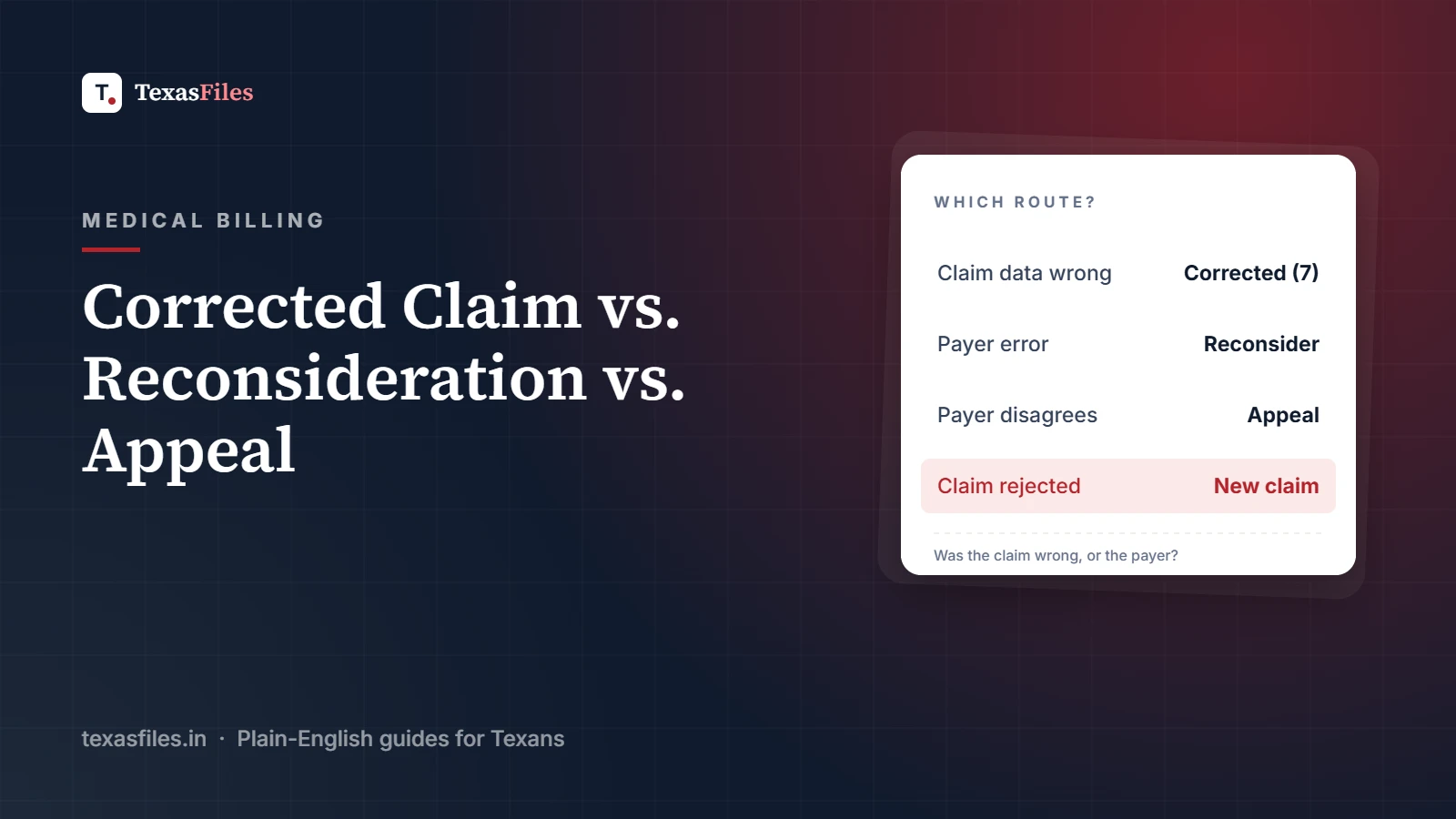
Corrected Claim vs. Reconsideration vs. Appeal: Which One to Use
When to send a corrected claim (frequency code 7 or 8), when to ask for reconsideration, and when to file a formal appeal, including Medicare reopenings and appeal deadlines.
·6 min read
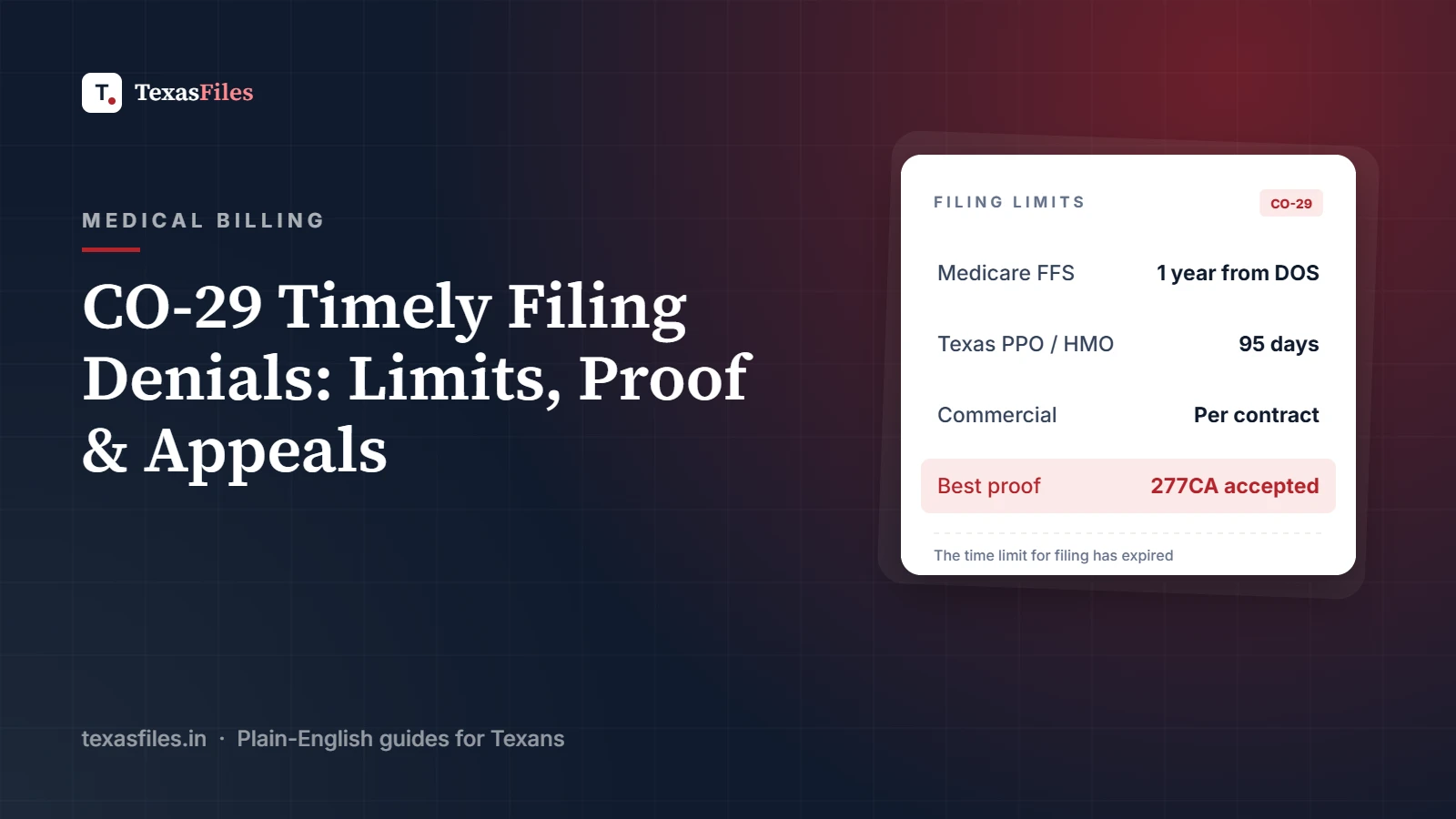
CO-29 Timely Filing Denials: Filing Limits, Proof, and How to Appeal
What a CO-29 timely filing denial means, Medicare's one-year limit, Texas's 95-day rule for insured plans, what counts as proof of timely filing, and how to appeal.
·5 min read
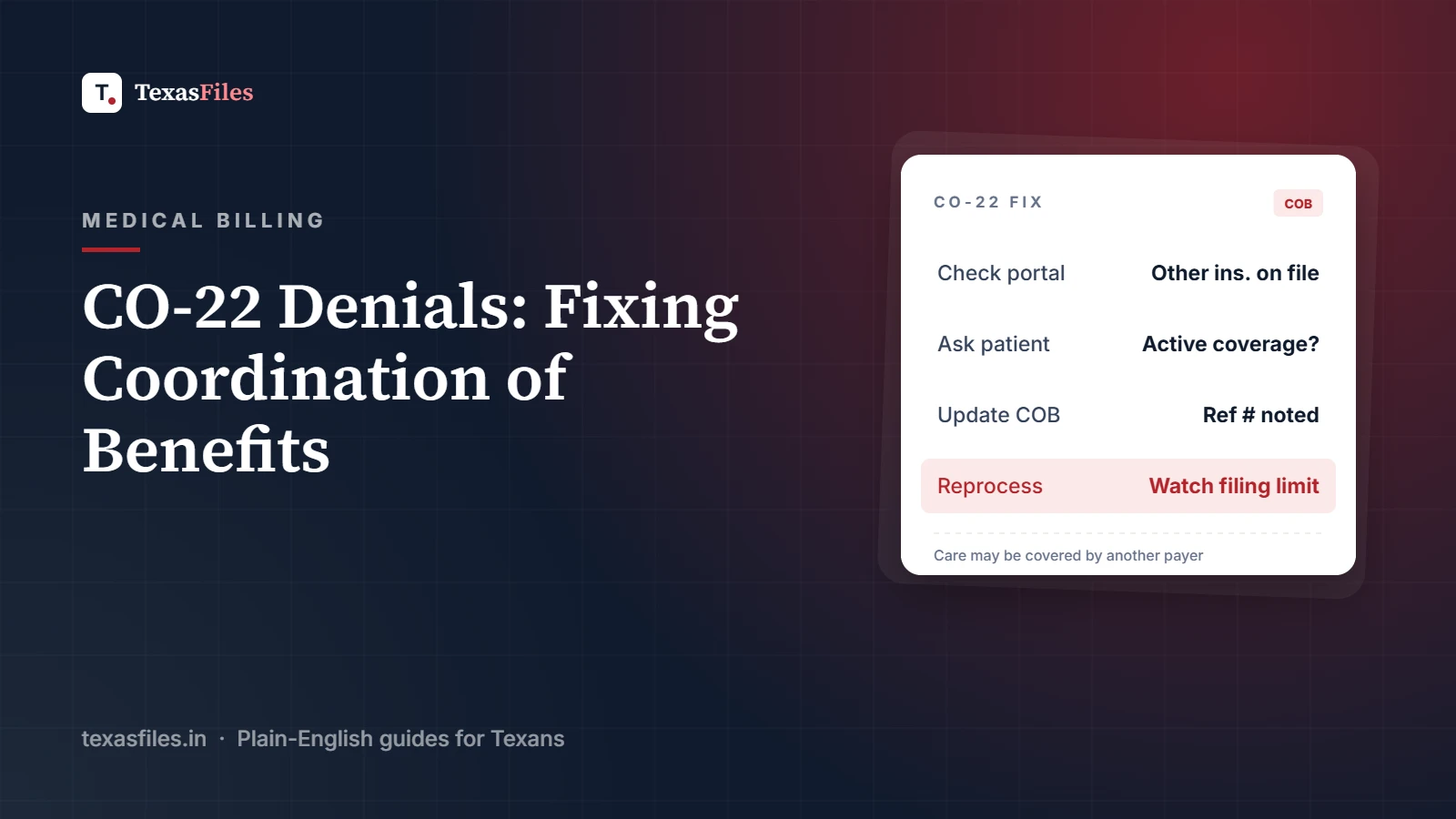
CO-22 Denial: How to Fix Coordination of Benefits Denials
What a CO-22 denial means, who pays first under COB and Medicare Secondary Payer rules, and a step-by-step process to get COB updated and claims reprocessed.
·6 min read