Medicare Open Enrollment 2026: A Plain-English Guide for Texans
Medicare Open Enrollment runs October 15 to December 7. Here is what you can change, how to compare plans in Texas without getting burned, and the mistakes that cost seniors money in January.
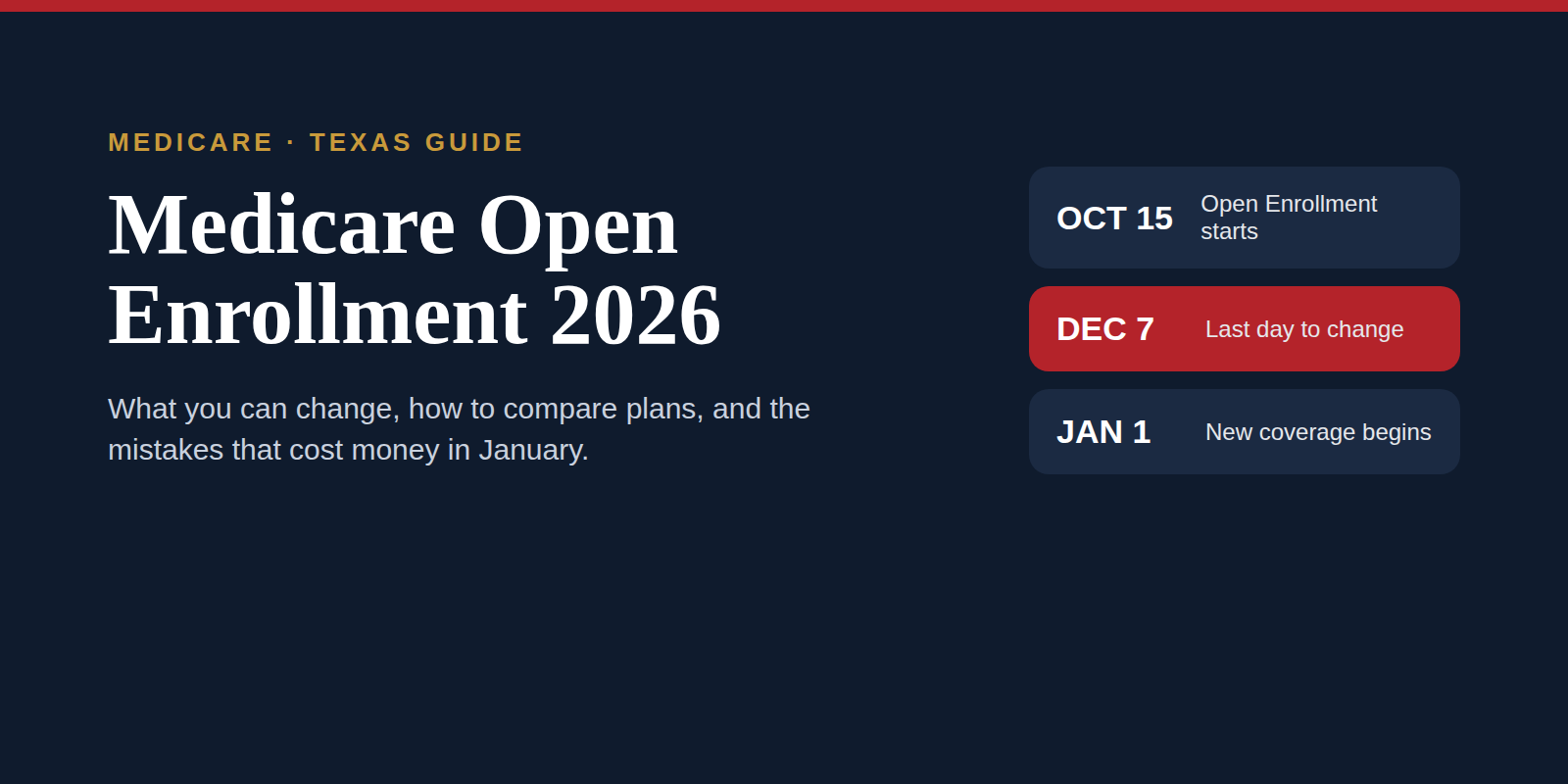
Every fall, Medicare gives you one window to change your coverage for the next year. For 2027 coverage, that window is October 15 to December 7, 2026. Whatever you choose takes effect on January 1, 2027.
If you do nothing, most plans simply renew. That sounds easy, but it's where many Texans lose money: plans change their premiums, drug lists, and doctor networks every year. This guide explains what you can change, how to compare plans, and how to avoid the surprises that show up on medical bills in January.
The key dates
- By September 30: your plan mails an Annual Notice of Change (ANOC) listing what changes next year. Read it.
- October 15 – December 7: Medicare Open Enrollment (also called the Annual Election Period).
- January 1: your new coverage starts, and most deductibles reset.
- January 1 – March 31: Medicare Advantage Open Enrollment. If you're in a Medicare Advantage plan, you can switch to a different one or go back to Original Medicare, once.
What you can change during Open Enrollment
- Switch from Original Medicare to a Medicare Advantage plan, or the other way around.
- Switch from one Medicare Advantage plan to another.
- Join, switch, or drop a Medicare drug plan (Part D).
What it doesn't cover: Medigap (Medicare Supplement) plans. Open Enrollment doesn't give you a right to buy a Medigap policy. Outside your one-time Medigap open enrollment period (the six months after you first enroll in Part B at 65 or older), insurers can usually ask health questions and charge more or turn you down. If you're thinking of leaving Medicare Advantage for Original Medicare plus Medigap, check that you can get a Medigap policy before you switch.
How to compare plans in 5 steps
1. Make two lists: your doctors and your prescriptions
Write down every doctor, specialist, and hospital you want to keep, and every medication with its dose. These two lists decide which plan is actually cheapest for you.
2. Use the official Medicare Plan Finder
Go to Medicare.gov Plan Finder and enter your ZIP code and drugs. It shows the estimated yearly cost for each plan, not just the premium. A $0-premium plan can still cost more if your drugs sit on a high tier or need prior authorization.
3. Check the network, not the advertisement
Medicare Advantage networks in Texas vary a lot from county to county, and an HMO usually pays nothing for non-emergency care outside its network. Call your doctors' offices and ask: "Will you be in-network with [plan name] in 2027?" Don't rely only on the plan's directory. Billing offices know which contracts are ending.
4. Compare the total cost, not just the premium
Add up the premium, the deductible, copays for the visits you usually have, and your drug costs. For Medicare Advantage, also look at the plan's maximum out-of-pocket limit, the most you'd pay for covered in-network care in a bad year. Not sure how deductibles and out-of-pocket limits work together? See deductible vs. out-of-pocket maximum explained.
5. Check the drug rules
Part D drug plans now have a yearly cap on what you pay out of pocket for covered drugs, and covered insulin is capped at $35 a month. Even so, check each plan's formulary (drug list), the tier of each drug, and whether it needs prior authorization or step therapy.
Common mistakes that cost Texans money
- Letting a plan auto-renew without reading the ANOC. A doctor leaving the network or a drug moving tiers can cost hundreds of dollars.
- Choosing a plan for the extras. Dental, vision, and grocery cards are nice, but they matter less than whether your doctors and drugs are covered.
- Trusting unsolicited calls. Medicare won't call you to sell a plan. Never give your Medicare number to someone who calls, texts, or knocks on your door uninvited.
- Forgetting to tell your doctor's office. If you change plans, bring your new card to your first appointment in January. Billing the old plan is one of the most common reasons claims get denied early in the year, and those denials can turn into bills sent to you.
What if you miss December 7?
If you're in a Medicare Advantage plan, you get one more chance from January 1 to March 31. Outside these windows, you can only change plans if you qualify for a Special Enrollment Period, for example if you move, lose other coverage, or move into or out of a nursing home. Our guide to special enrollment periods and qualifying life events explains how those work.
Free, unbiased help in Texas
- Texas HICAP (Health Information Counseling and Advocacy Program) offers free, one-on-one Medicare counseling through Texas Health and Human Services. Call 1-800-252-9240. HICAP counselors don't sell insurance.
- 1-800-MEDICARE (1-800-633-4227), 24 hours a day.
- Help paying costs: if your income is limited, ask about Extra Help for drug costs and the Medicare Savings Programs, which can pay your Part B premium. You can apply for the savings programs through Texas Health and Human Services.
Frequently asked questions
Do I have to do anything during Open Enrollment?
No. If you're happy with your coverage and it's still offered, it usually renews automatically. But read your Annual Notice of Change first, because the same plan can cost more or cover less next year.
Can I switch Medigap plans during Open Enrollment?
Open Enrollment doesn't give you special rights to change Medigap plans. You can apply any time, but the insurer may ask health questions.
When does my new plan start?
Changes made between October 15 and December 7 start on January 1. If you make several changes, the last one you make before December 7 is the one that counts.
Why did my bills go up in January?
Most deductibles reset on January 1, so your first visits of the year may cost more until you meet the new deductible. Ask your doctor's office for an estimate if you're unsure.
Read next: Navigating Medicare guidelines for seniors over 65 and why you should always ask for an itemized medical bill.
This guide explains general Medicare rules. Plan costs and benefits change every year, so confirm the details for your ZIP code on Medicare.gov or with a HICAP counselor.
Written by Ashim
Ashim works in US medical billing and revenue cycle management, handling claim follow-up, denials and appeals every day.
Read our editorial policy. Spotted something outdated? Tell us.
Keep reading

Navigating Medicare Guidelines for Seniors Over 65
Who qualifies for Medicare, what Parts A, B, C, D and Medigap cover, when to enroll, and how Texans can avoid late penalties and get free help.
·6 min read
Texas Surprise Billing Law (SB 1264): A Guide for Out-of-Network Providers
How Texas SB 1264 bans surprise balance billing, which plans it covers, the waiver rule, and how out-of-network providers request TDI arbitration.
·3 min read
How to Work UnitedHealthcare Claims: Status, Reconsiderations, and Appeals
How to check UHC claim status, choose between corrected claims and reconsiderations, file appeals within 12 months, and fix common denials.
·4 min read