Common Claim Denial Codes (CARC & RARC): What They Mean and How to Fix Them
How to read group codes, CARCs and RARCs on an ERA, plus what CO-16, CO-97, CO-22, CO-29, CO-50, CO-197 and other common denial codes mean and how to fix each one.
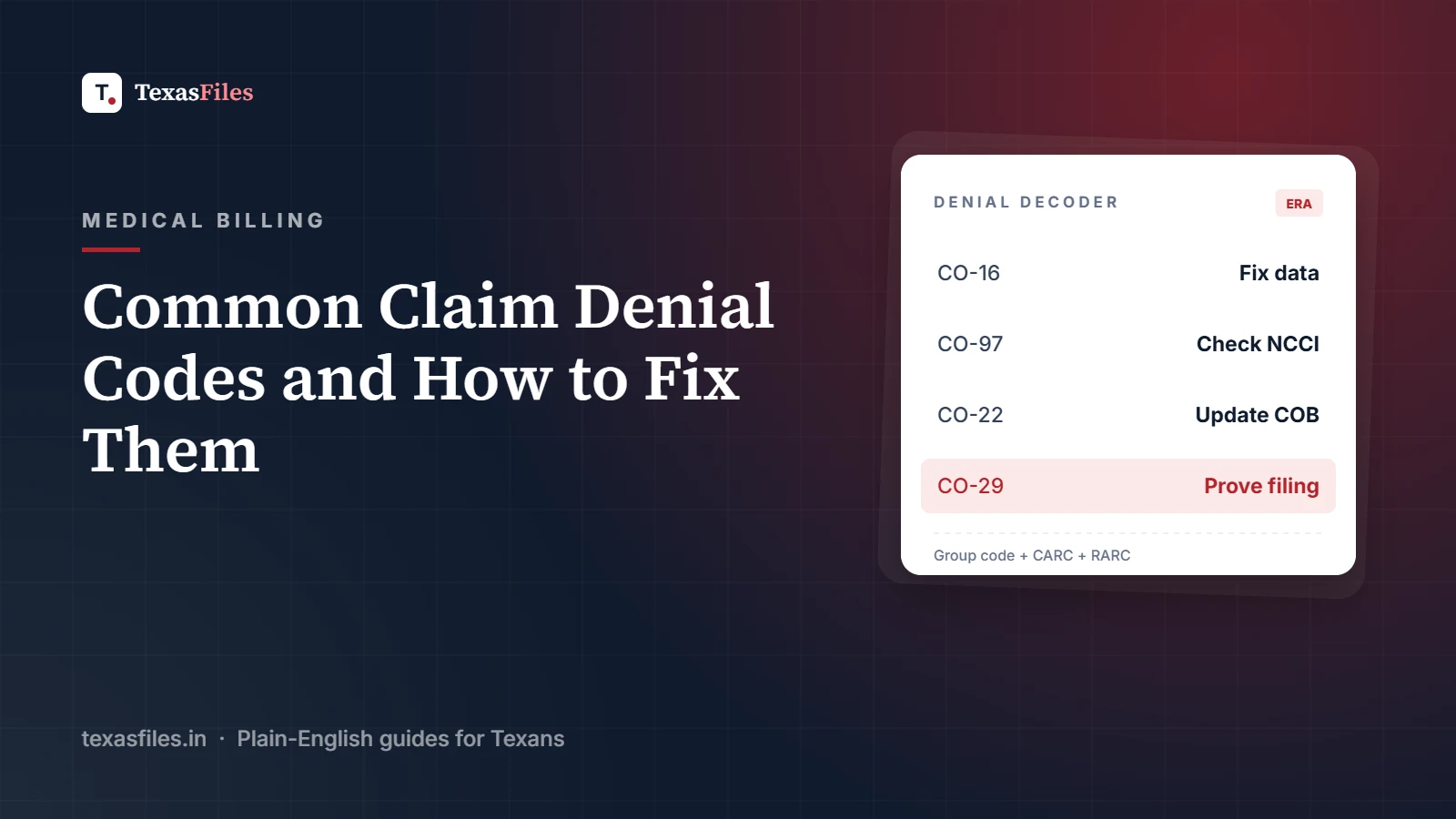
Every denied claim comes back with a short code on the remittance: CO-16, CO-97, PR-1, sometimes with an N or MA code next to it. Those codes are the payer telling you exactly why it didn't pay. Billers who can read them quickly fix denials in minutes. Billers who can't end up calling the payer for answers that were already on the ERA.
This guide explains how denial codes are built, then walks through the codes we see most often in day-to-day claim follow-up, what each one really means, and the fastest fix for each.
How to Read a Denial Code: Group Code + CARC + RARC
A denial on an 835 electronic remittance (ERA) or paper Explanation of Benefits usually has three parts:
Group code: who is responsible for the adjusted amount. CO (Contractual Obligation) means the provider must write it off and can't bill the patient. PR (Patient Responsibility) means the patient can be billed, such as deductible, coinsurance or copay. OA (Other Adjustment) and PI (Payer Initiated Reductions) cover other situations.
CARC (Claim Adjustment Reason Code): the reason for the adjustment, such as 16, 29 or 97. These codes are maintained by X12 and used by every HIPAA-covered payer.
RARC (Remittance Advice Remark Code): extra detail, such as M51 or N4. Some CARCs, including 16, must come with at least one RARC, and the remark code is often where the real answer is.
So CO-16 with M51 means: the provider owns this adjustment, the claim has a submission or billing error, and specifically the procedure code is missing, incomplete or invalid. Read the RARC every time; it usually tells you exactly what to fix.
The Most Common Denial Codes and How to Fix Them
CO-16: Claim lacks information or has submission/billing errors
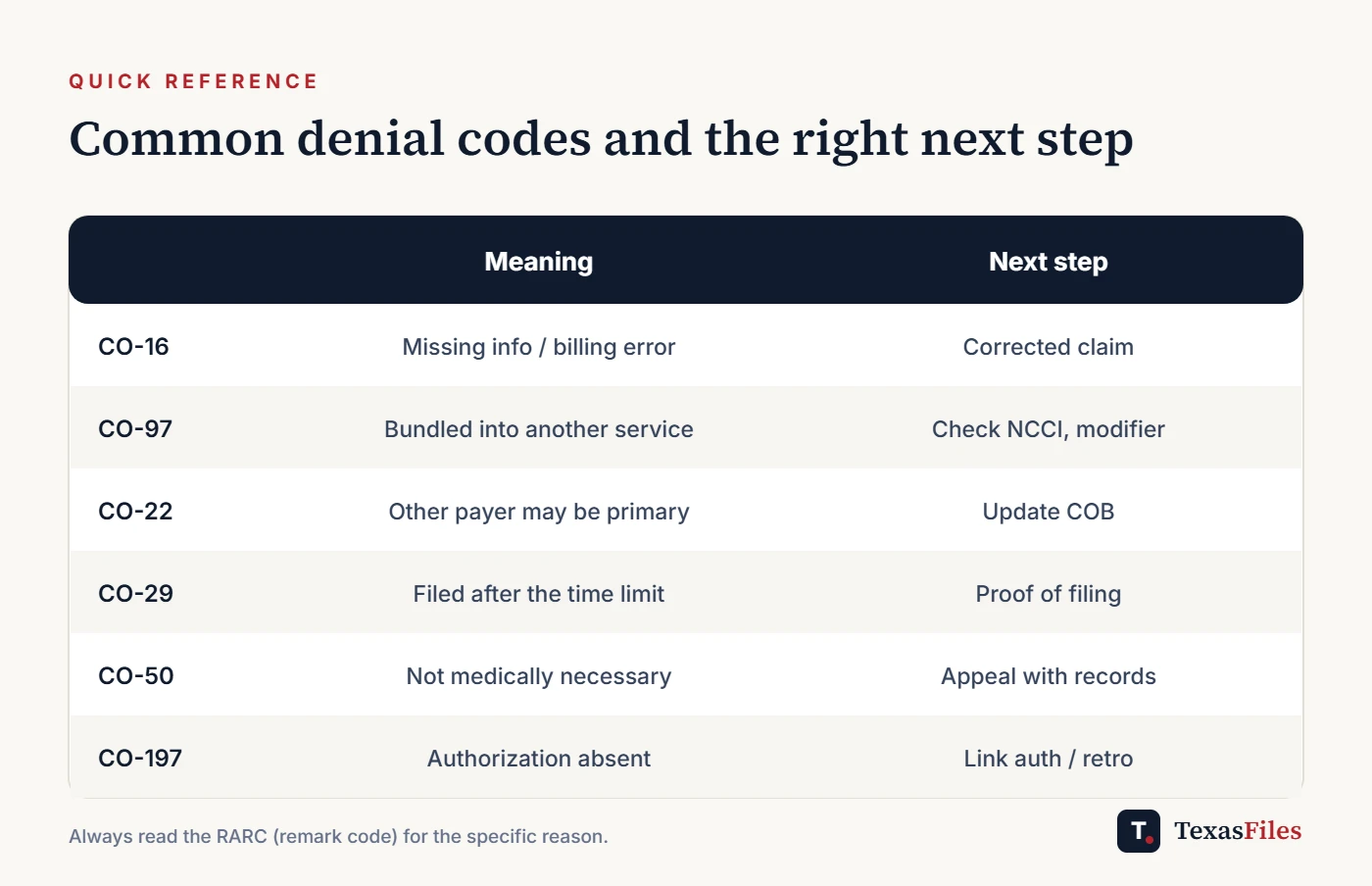
The official description is "Claim/service lacks information or has submission/billing error(s)." It's a catch-all, which is why the RARC matters. Common pairings include M51 (missing or invalid procedure code), MA130 (incomplete or invalid information, no appeal rights, submit a new claim) and N4 (missing or invalid prior insurance EOB).
Fix: Read the RARC, correct the data in your practice management system, and send a new or corrected claim. Don't appeal a CO-16; there's nothing to argue, only data to fix. Our guide to corrected claims vs. appeals explains which route to use.
CO-97: Benefit included in another service already paid
CO-97 means the payer considers this service bundled into another service it already paid, often because of NCCI procedure-to-procedure edits. A classic example is a minor procedure billed with an E/M visit on the same day without modifier 25, or two procedures where one is considered a component of the other.
Fix: Check the NCCI edit for the code pair. If the documentation supports a separate, distinct service and the edit allows a modifier, add the correct modifier (25, 59 or an X modifier) and send a corrected claim. If the edit doesn't allow a modifier, the bundling is correct and the line is a write-off. A claim scrubber that checks NCCI edits catches most of these before submission.
CO-4: Procedure code inconsistent with the modifier
The modifier doesn't fit the code: modifier 26 on a code with no professional component, a missing LT/RT, or a modifier the payer doesn't accept for that service.
Fix: Confirm the correct modifier from the code's description and the payer's policy, then correct and resubmit.
CO-11 and CO-167: Diagnosis issues
CO-11 means "The diagnosis is inconsistent with the procedure." CO-167 means the diagnosis itself isn't covered. Both often come down to the claim carrying a vague or wrong ICD-10 code when the chart supports a more specific one.
Fix: Review the documentation. If a more specific, supported diagnosis was missed, correct the claim. If the diagnosis on the claim is accurate and still not covered under the payer's policy, it's a coverage issue, not a coding error. Our guide to CPT and ICD-10 codes covers the basics.
OA-18: Exact duplicate claim
X12 reserves reason code 18 for group code OA (outside some workers' compensation rules), though billers often call it a "CO-18." Either way, it means the payer already has this claim. This happens when claims are resubmitted while the first one is still processing, or when a corrected claim is sent as a brand-new claim instead of a replacement.
Fix: Check claim status first. If the original was paid or is in process, there's nothing to do. If you were trying to correct the original, resend it as a replacement claim (frequency code 7) with the original claim number, not as a new claim.
CO-22: Care may be covered by another payer
The payer thinks another plan is primary. This is one of the most common denials in claim follow-up, and it's often caused by the patient's coordination of benefits (COB) record being out of date rather than by a real second plan. See our full guide to fixing CO-22 coordination of benefits denials.
CO-27: Expenses incurred after coverage terminated
The patient's coverage ended before the date of service. Fix: Check eligibility for the date of service, ask the patient for new insurance, and bill the correct plan. If the termination was retroactive, ask the payer for the termination date in writing.
CO-29: Time limit for filing has expired
The claim reached the payer after its timely filing deadline. These are only winnable with proof that the original claim was filed on time. Our guide to CO-29 timely filing denials covers limits and proof.
CO-50: Not medically necessary
The payer decided the service wasn't medically necessary for the diagnosis on the claim. Fix: First confirm the diagnosis on the claim matches the chart. If it does, this is a true appeal: send records and, ideally, a letter of medical necessity from the provider (see how to appeal a denied claim). For Medicare, check the NCD or LCD; if an ABN wasn't signed, the provider generally can't bill the patient.
CO-197: Authorization absent
"Precertification/authorization/notification/pre-treatment absent." Fix: Check whether an authorization exists under a different provider, date range or CPT code; payers often deny when the auth doesn't exactly match the claim. If one exists, ask the payer to link it and reprocess. If not, ask whether a retro-authorization is allowed. Read more in prior authorization explained.
CO-45: Charge exceeds the fee schedule
Not really a denial. CO-45 is the contractual write-off between your billed charge and the allowed amount. Only question it if the allowed amount doesn't match your contract.
PR-1, PR-2 and PR-3: Patient responsibility
Deductible, coinsurance and copay. These aren't denials either; the payer processed the claim correctly and the balance moves to the patient.
CO-109: Not covered by this payer
"You must send the claim/service to the correct payer/contractor." Common with Medicare Advantage patients billed to traditional Medicare, or with plans that use a separate administrator for certain benefits. Fix: Find the correct payer from the ID card or eligibility response and bill there.
Denial or Rejection? Know the Difference
A rejection happens before the payer accepts the claim, at the clearinghouse or the payer's front end, usually for formatting or demographic errors. A rejected claim never entered the payer's system, so you fix and resubmit it as a new claim. A denial happens after the payer processed the claim. A denied claim exists in the payer's system, so you correct, reconsider or appeal it. Mixing these up is a top cause of duplicate-claim (code 18) denials and missed deadlines.
A Simple Denial Workflow That Works
Work denials by code, not by patient. Group the week's denials by CARC and fix the same problem in batches.
Fix the root cause. Ten CO-16/M51 denials in a week point to a charge entry or mapping problem, not ten separate mistakes.
Log every action. Note the date, payer, status and claim number for every follow-up so anyone on the team can pick up the account.
Track deadlines. Appeals and corrected claims have their own time limits, often shorter than you'd expect.
Frequently Asked Questions
What is the difference between CO and PR denials?
CO means the adjusted amount is the provider's contractual responsibility, so it can't be billed to the patient. PR means the amount is the patient's responsibility, such as a deductible or coinsurance, and can be billed to the patient.
Where can I look up a CARC or RARC?
X12 publishes the official lists of Claim Adjustment Reason Codes and Remittance Advice Remark Codes on its website, and they are updated several times a year.
Should I appeal a CO-16 denial?
Usually not. CO-16 means information is missing or wrong. Fix the data identified by the remark code and send a corrected or new claim instead of an appeal.
Why do some denials have no remark code?
Not every CARC requires a RARC. When the reason isn't clear, check the payer portal's claim detail or call the payer and ask for the specific reason and what's needed to reprocess.
The Bottom Line
Denial codes are a set of precise instructions. Read the group code to know who owns the balance, the CARC to know why, and the RARC to know exactly what to fix. Then decide: correct the claim, request reconsideration, or appeal. Most denials are fixed with the first option.
Sources
Written by Ashim
Ashim works in US medical billing and revenue cycle management, handling claim follow-up, denials and appeals every day.
Read our editorial policy. Spotted something outdated? Tell us.
Keep reading
Common Causes of CO-97 Denials (and How to Fix Them)
CO-97 means the payer bundled a service into another one. Learn the common causes, like NCCI edits, missing modifiers, and global periods, and how to fix them.
·4 min read
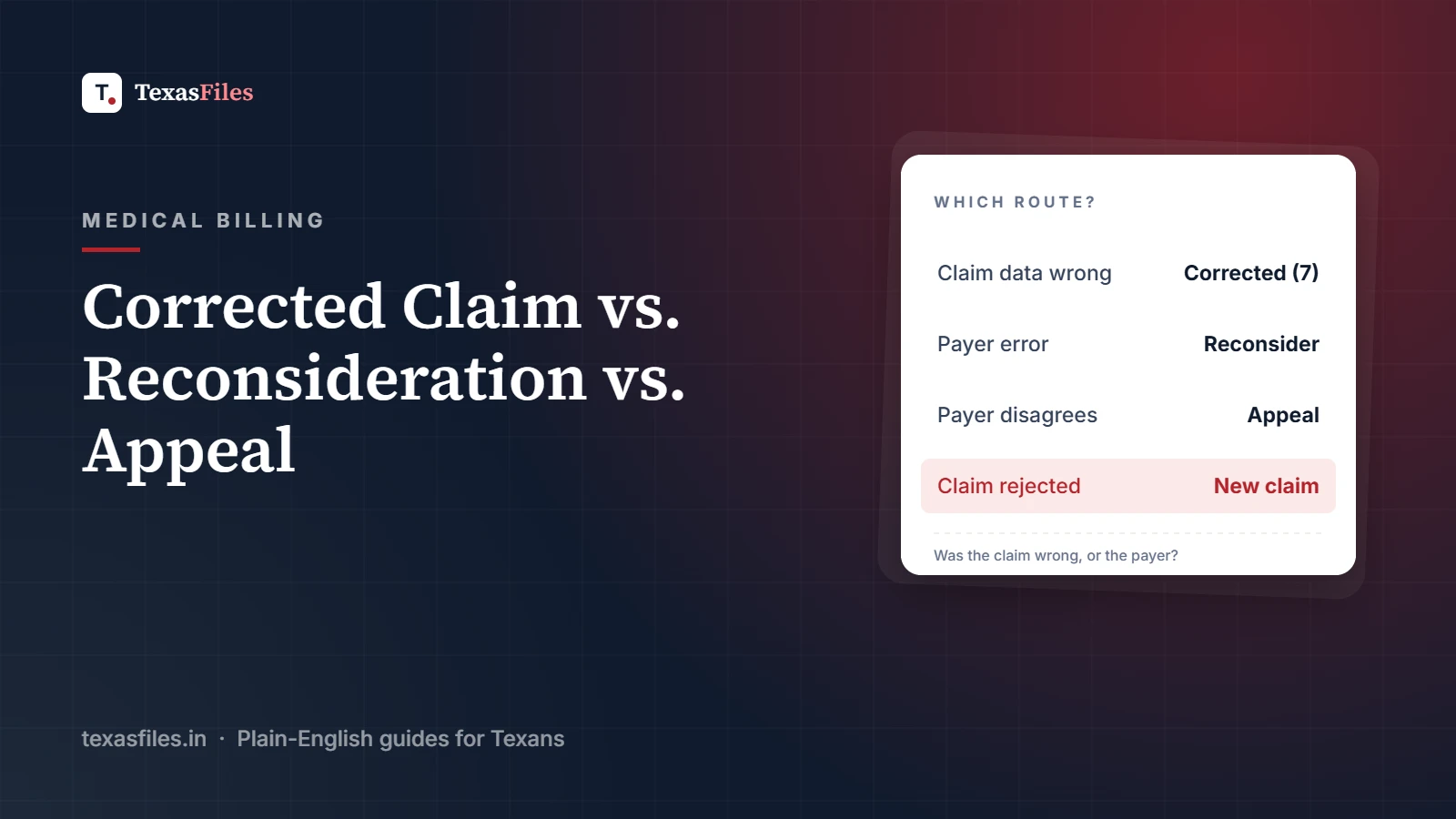
Corrected Claim vs. Reconsideration vs. Appeal: Which One to Use
When to send a corrected claim (frequency code 7 or 8), when to ask for reconsideration, and when to file a formal appeal, including Medicare reopenings and appeal deadlines.
·6 min read
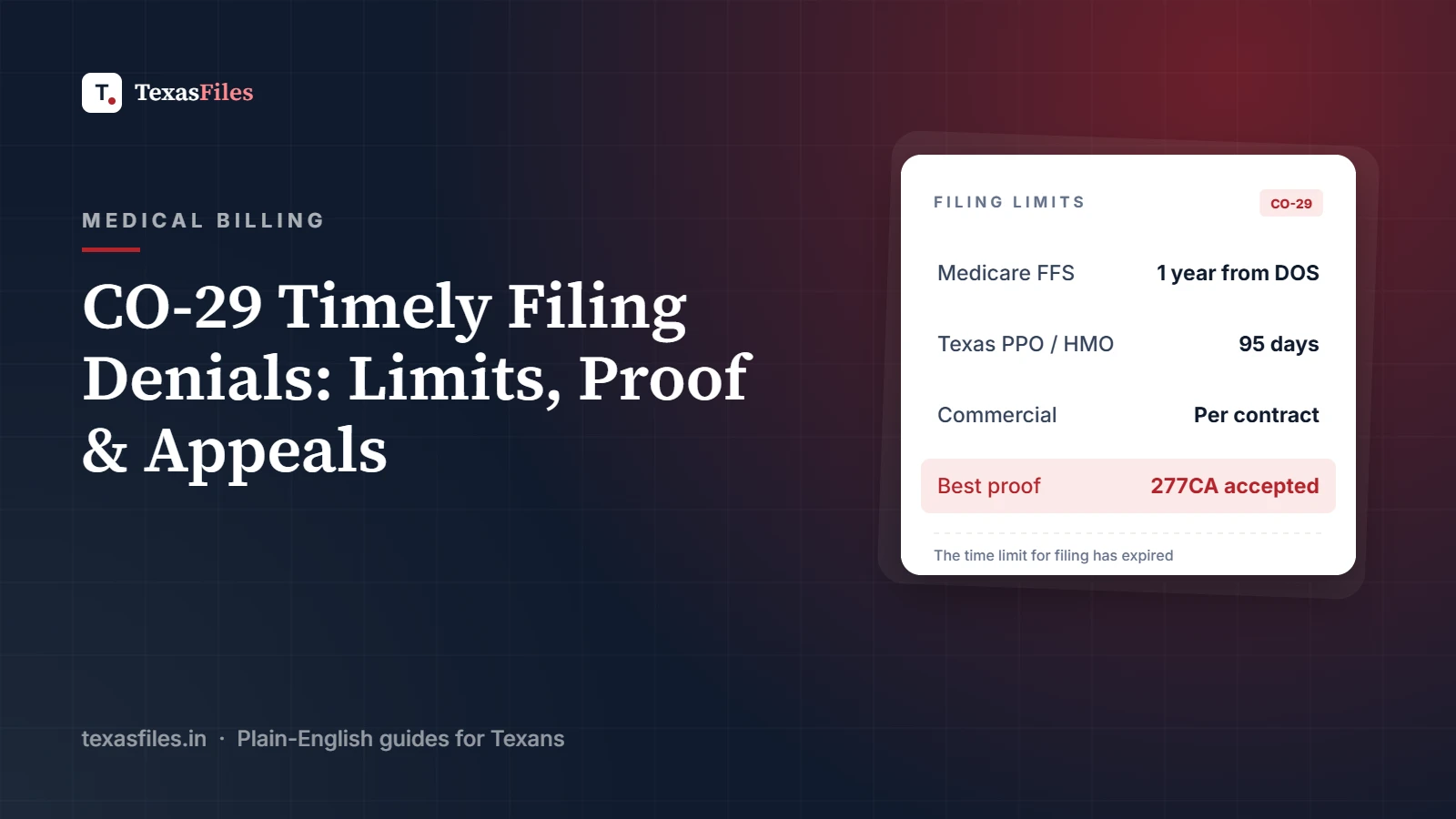
CO-29 Timely Filing Denials: Filing Limits, Proof, and How to Appeal
What a CO-29 timely filing denial means, Medicare's one-year limit, Texas's 95-day rule for insured plans, what counts as proof of timely filing, and how to appeal.
·5 min read